Impact criteria
GWP - Global warming potential
Description : Global warming potential (GWP) is the heat absorbed by any greenhouse gas in the atmosphere, as a multiple of the heat that would be absorbed by the same mass of carbon dioxide (CO2). GWP is 1 for CO2. For other gases it depends on the gas and the time frame.
Source : https://en.wikipedia.org/wiki/Global_warming_potential
Unit : kgCO2e
ADPe - Abiotic Depletion Potential
Description : Use of mineral and metal resources.
Source: Life Cycle Assessment & the EF methods
Unit : KgSbeq
This impact category has the same underlying basic idea as the impact category resource use, fossils (namely, extracting a high concentration of resources today will force future generations to extract lower concentration or lower value resources). The amount of materials contributing to resource depletion are converted into equivalents of kilograms of antimony (kg Sb eq).
PM - Particulate matter
Description : Fine particle emissions
Source : Life Cycle Assessment & the EF methods
Unit : Disease occurrence
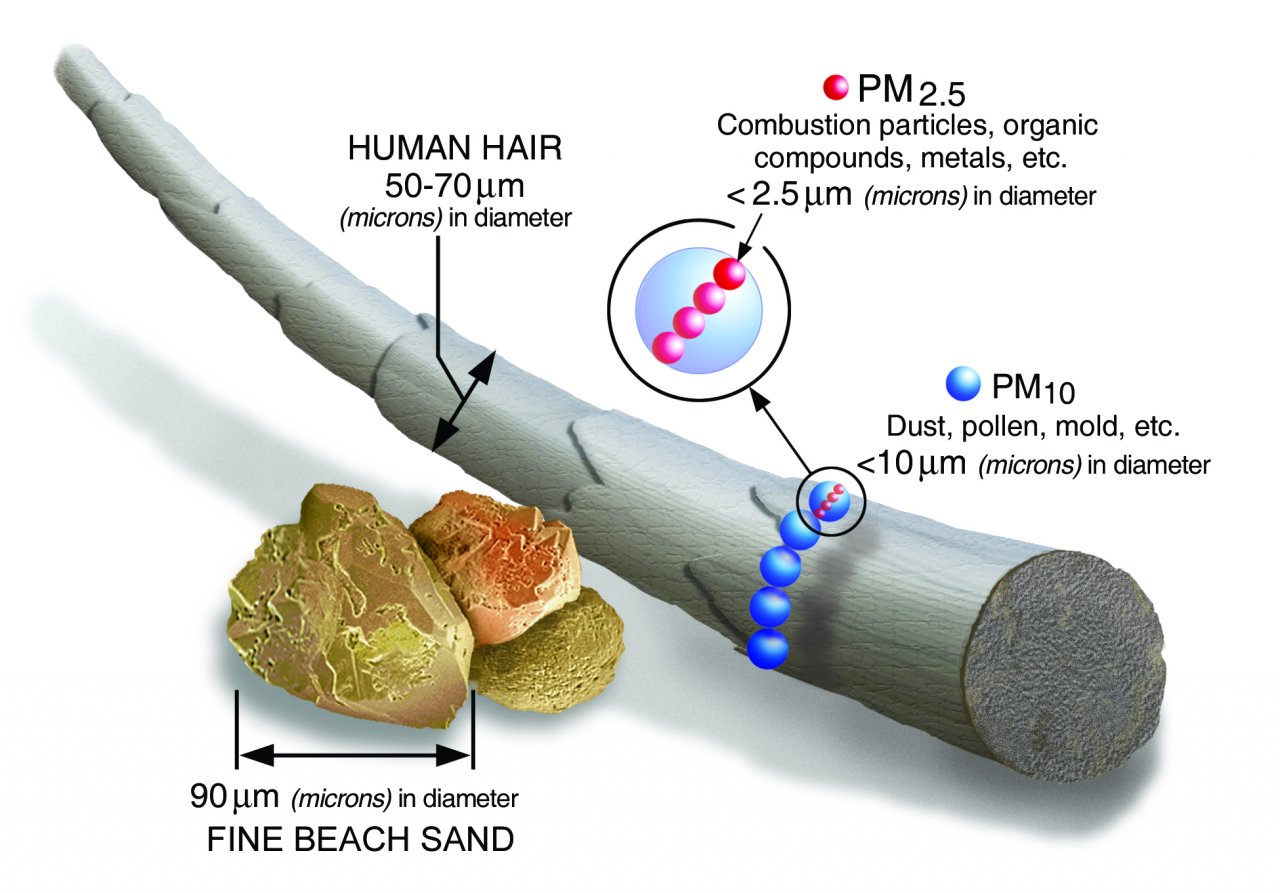
Particulate matter size comparison from EPA.gov
Explanation of the harmful effect of particulate matter on EPA website.
AP - Acidification
Description : Acidification
Source : Life Cycle Assessment & the EF methods
Unit : mol H+ eq.
Description from PEF:
Acidification has contributed to a decline of coniferous forests and an increase in fish mortality. Acidification can be caused by emissions to the air and deposition of emissions in water and soil. The most significant sources are combustion processes in electricity, heat production, and transport. The more sulphur the fuels contain the greater their contribution to acidification. The potential impact of substances contributing to acidification is converted to the equivalent of moles of hydron (general name for a cationic form of atomic hydrogen, mol H+ eq).
WU - Use of water resources
Description: Use of water resources
Source : Life Cycle Assessment & the EF methods
Unit: m3 eq.
Description from PEF:
The abstraction of water from lakes, rivers or groundwater can contribute to the ‘depletion’ of available water. The impact category considers the availability or scarcity of water in the regions where the activity takes place, if this information is known. The potential impact is expressed in cubic metres (m3 ) of water use related to the local scarcity of water.